
Quick Summary
VOWST® and other fecal microbiota transplants (FMT) are designed to help prevent recurrent C. difficile infections after antibiotics. The big question people have is whether probiotics, toxin binders, or herbal antimicrobials are safe to use afterward — and if so, when. The short answer: timing and sequence matter most.
Watch the Video
VOWST & Probiotics Together — Is It Safe (or Smart)?
In this video, Michelle explains practical timing after VOWST or FMT: when to hold, when to add IgG binders, how to reintroduce probiotics, and where botanicals fit later.
What Are VOWST and FMT—And How Do They Help With Recurrent C. diff?
VOWST® is an FDA-approved oral microbiota spore capsule that helps prevent recurrence of C. diff after antibacterial treatment. REBYOTA® is also FDA-approved and is a single-dose rectal suspension given in a clinical setting.
Other fecal transplant procedures that aren’t formally FDA-approved can still be offered by certain doctors or clinics under what’s called “enforcement discretion.” That simply means the FDA currently allows their use for treating recurrent C. difficile as long as safety guidelines and donor screening are followed — even though those products haven’t gone through the full drug-approval process yet.
All of these aim to restore beneficial gut bacteria lost from antibiotics.
Why Advice on Probiotics After VOWST or FMT Is So Mixed

The VOWST label clearly says not to take antibiotics at the same time, but it doesn’t provide any guidance about probiotics or supplements. Because these microbiome therapies are still new, many doctors take a cautious approach.
Most advice to “avoid probiotics” is based on the absence of data — not because proven harm exists.
A practical theme from research and clinical use is to let early engraftment happen first, then add support gradually as tolerance allows.
The Phases of Recovery—And Where Supplements Fit
| Phase | Timing | Focus | What’s Usually Added |
|---|---|---|---|
| Engraftment | Days 0–7 | Let donor microbes take hold | Hold probiotics, binders, and antimicrobials; focus on gentle foods and hydration |
| Early Recovery | Weeks 2–3 | Calm and stabilize | With your provider’s guidance, consider gentle IgG binders that help neutralize toxins without disturbing gut flora |
| Recolonization | Weeks 3–5 | Rebuild beneficial diversity | Start low-dose spore-based probiotics (Bacillus species) or S. boulardii; add one at a time, increase slowly |
| Maintenance | Weeks 5–8 | Support long-term stability | Add broader toxin binders (charcoal, clay, GI Detox+) if needed; take away from meds or supplements by 1–2 hours |
| Late Maintenance | Weeks 6–10+ | Address lingering issues | With guidance, consider herbal antimicrobials like Biocidin® or Olivirex®; start low and monitor tolerance |
| Long-Term | Month 3+ | Maintain diversity naturally | Slowly reintroduce fermented foods; continue core probiotic support |
Educational reference only — timing and supplement use after FMT or VOWST should always be discussed with your doctor.
Quick Guide
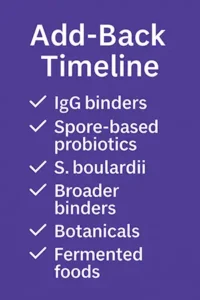
Probiotics: Spore-based Bacillus strains and S. boulardii can often be added back during the recolonization phase.
Binders: IgG binders early; charcoal or clay binders later (away from medications).
Botanicals: Products like Biocidin® or Olivirex® are best added later (6 weeks plus), once gut stability returns with your provider’s approval.
Grab a printable one-pager showing the timing for IgG binders, spore-based probiotics, S. boulardii, broader binders, botanicals, and fermented foods:
>> Add-Back Timeline After FMT or VOWST (PDF Download) <<<
Note: While FMT and VOWST aim to restore balance using donor microbes, some people find they still need additional microbiome support afterward. Probiotic therapies — especially spore-based and yeast probiotics — can help strengthen gut diversity and function when recovery feels incomplete or when previous microbiome therapies haven’t fully taken hold – always under your provider’s guidance.
Find out more: How to Choose the Best Probiotic for C. diff
Pros and Cons at a Glance

VOWST: Convenient oral capsules, clinically studied for preventing recurrence, but costly (around $17,500), prescription only, and is not fully effective in every case.
REBYOTA: Single-dose clinical treatment with strong trial data; but invasive, expensive (around $9,000), and relapse can still occur.
Traditional FMT: Broader microbial diversity and longer history of use, but donor variability and infection risks remain.
Probiotic Therapies: Probiotic therapies are often used to restore balance after antibiotics or when microbiome therapies such as FMT or VOWST don’t fully take hold. These targeted microbial supports are typically lower in cost, flexible, and helpful for rebuilding long-term gut balance — but quality, strain choice, and timing are key for best results.
Learn More
See our full FMT overview here:
Fecal Transplants: Too Good to Be True?
The Best Probiotics and Binders for C. difficile Recovery to learn more about probiotic and binder options for gut recovery.
Frequently Asked Questions
Could probiotics “mess up” FMT or VOWST?
The concern is mostly timing. Give the new microbiota a short period to settle first. Later, targeted probiotics can support diversity — always work with your provider.
How long should I wait?
Many clinicians wait about 3–5 weeks after FMT before adding Bacillus or S. boulardii, adjusting case-by-case.
Are binders safe after FMT?
Narrow IgG binders are often introduced earlier; broader binders later. Confirm timing with your provider.
What about fermented foods?
Usually reintroduced around 3 months post-FMT, starting small and monitoring tolerance.
Does the VOWST label mention probiotics?
The label only advises avoiding antibiotics at the same time. It doesn’t prohibit probiotics, but discuss supplement timing with your doctor.
Disclaimer: This information is for educational purposes only. It is not medical advice and is not affiliated with or endorsed by the makers of VOWST®, REBYOTA®, or any other FMT product. Always talk with your healthcare provider before changing or starting any supplements or therapies after FMT.

About the Author – Michelle Moore, BSc
Michelle Moore is a microbiologist, holistic health educator, and author of C. difficile Treatments & Remedies. With over 10 years of experience in pharmaceutical research and over 20 years in natural medicine, she helps people overcome C. difficile and other chronic infections naturally.
References
Label reference: VOWST® Prescribing Information (Seres Therapeutics/Nestlé HealthScience/Aimmune).
Label reference: REBYOTA® Prescribing Information includes access to the full prescribing info.
Guideline/context: AGA Clinical Practice Guideline on Fecal Microbiota‑Based Therapies for Select Gastrointestinal Diseases — Peery AF, Kelly CR et al. Gastroenterology. 2024 Mar;166(3):409-434. DOI 10.1053/j.gastro.2024.01.008.
VOWST: 3-day course list price ~$17,500, The Medical Letter. 2024. https://secure.medicalletter.org/TML-article-1677a
REBYOTA: Price listed around $9,000 for a single dose unit. https://www.drugs.com/price-guide/rebyota